Big 5 Personality Test: Find Your Ideal Career Fit by Trait
Discovering your optimal career path requires profound self-awareness. Taking a Big 5 personality test offers a powerful, data-driven lens to understand where you'll naturally thrive professionally. This guide explores how the five core dimensions—Openness, Conscientiousness, Extraversion, Agreeableness, and Neuroticism (OCEAN)—correlate with specific careers and work environments, helping you align your unique self with your ideal job.
This framework, trusted by psychologists worldwide, provides a scientific foundation for career planning. Instead of guessing, you can use your core traits to identify roles that energize and fulfill you. Ready to uncover your potential? Start by understanding your personality profile and see how it maps to a rewarding career.
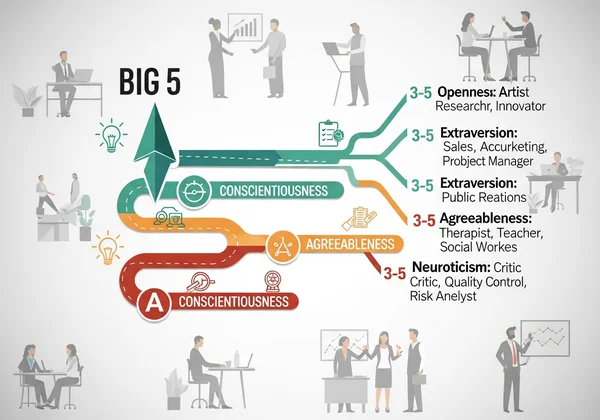
Openness to Experience: Innovators and Visionaries in the Workforce
Openness is the dimension of personality that reflects your curiosity, creativity, and appreciation for new ideas. It determines whether you are an imaginative explorer or a pragmatic traditionalist. Both ends of this spectrum hold unique strengths valued in different professional settings.
High Openness: Exploring Creative, Intellectual, and Unconventional Fields
Individuals with high Openness are driven by a thirst for knowledge and novel experiences. They are abstract thinkers, innovators, and artists who flourish in environments that lack rigid structure. If you score high in this trait, you likely feel stifled by routine and repetitive tasks. Your ideal career will challenge you intellectually and allow for creative expression.
Think about roles where you can generate new ideas, solve complex problems, or create something original. Creative careers like graphic design, writing, or marketing strategy are excellent fits. Similarly, intellectual jobs in scientific research, philosophy, or software development allow you to explore theories and build innovative systems. Unconventional fields such as entrepreneurship, documentary filmmaking, or sustainable architecture also align perfectly with a highly open personality.
Low Openness: Excelling in Structured, Practical, and Traditional Roles
Low Openness signifies a preference for the concrete, conventional, and practical. People with this trait are grounded, straightforward, and value tradition and stability. They excel in roles with clear procedures and predictable outcomes, bringing consistency and reliability to their work.
If you score lower on Openness, you are likely to thrive in structured work environments. Careers in finance, accounting, data entry, and law enforcement benefit from your focus and preference for established rules. Practical jobs such as logistics management, civil engineering, or quality assurance depend on the kind of methodical approach you bring. These roles are the backbone of many industries, requiring a steady hand and a respect for proven methods. Finding the right personality job fit is key to long-term satisfaction.

Conscientiousness: The Achievers, Organizers, and Detail-Oriented Professionals
Conscientiousness is the personality trait of being diligent, organized, and self-disciplined. It's a powerful predictor of success across many professions, but the way it manifests can lead you down very different career paths. Whether you are highly meticulous or more flexible and spontaneous, there is a work style that fits you perfectly.
High Conscientiousness: Dominating Roles Requiring Precision, Planning, and Discipline
Highly conscientious individuals are the planners, organizers, and achievers of the world. They have a strong sense of duty, are detail-oriented, and possess the discipline to see complex projects through to completion. If this describes you, you'll excel in careers where precision and reliability are paramount.
Consider roles in project management careers, where your ability to plan, execute, and monitor progress is invaluable. Analytical roles in fields like finance, data science, and surgery reward meticulous attention to detail. Any profession that involves managing resources, adhering to strict standards, or long-term strategic planning—such as architecture or financial planning—is an ideal match for your strengths.
Low Conscientiousness: Thriving in Flexible, Spontaneous, and Dynamic Environments
Those with lower scores in Conscientiousness are not lazy; they are simply more adaptable, spontaneous, and comfortable with ambiguity. They often dislike rigid schedules and prefer to work in bursts of inspiration. This flexibility can be a tremendous asset in fast-paced and ever-changing work environments.
Your strength lies in adaptability. Flexible jobs in fields like sales, emergency services, or event planning allow you to react to situations as they unfold. Dynamic work environments, such as those found in startups or creative agencies, value your ability to pivot quickly and brainstorm on the fly. You might also find success in creative roles with autonomy, like journalism or consulting, where you can follow your inspiration rather than a strict to-do list.

Extraversion: Leaders, Communicators, and Social Connectors
Extraversion measures how you derive energy—from interacting with others (extraverts) or from solitary reflection (introverts). This fundamental difference has a profound impact on which work environments feel draining versus energizing, making it a critical factor in finding your ideal big 5 career match.
High Extraversion: Excelling in People-Facing, Energetic, and Influential Positions
Extraverts are energized by social interaction. They are often assertive, talkative, and enthusiastic, making them natural communicators and leaders. If you are highly extraverted, a job that keeps you isolated will quickly drain your motivation. You need to be where the action is.
Look for people-facing roles where you can build relationships and influence others. Sales careers, public relations jobs, and management positions are classic fits. Leadership roles of any kind allow you to inspire teams and drive initiatives forward. Other suitable professions include teaching, event coordinating, and human resources, where your social energy is a core asset.
Low Extraversion (Introversion): Finding Success in Independent, Reflective, and Deep Work
Introverts gain energy from spending time alone. They are often thoughtful, observant, and prefer deep, meaningful conversations over small talk. The modern workplace can sometimes feel designed for extraverts, but there are countless professions where an introvert’s ability to focus and work independently is a superpower.
The best jobs for introverts allow for deep work and concentration. Think of research careers, programming, writing, or graphic design. These individual contributor roles let you dive into a project without constant interruption. The rise of remote jobs has also opened up new possibilities, allowing introverts to create a quiet and productive work environment that perfectly suits their needs. A scientific personality test can confirm where you fall on this spectrum.

Agreeableness: Collaborators, Caregivers, and Harmonizers
Agreeableness reflects your tendency to be cooperative, compassionate, and considerate of others. It influences how you handle conflict, work in teams, and build relationships. Both high and low agreeableness can be advantageous, depending on the demands of the profession.
High Agreeableness: Nurturing Roles in Service, Community, and Team-Oriented Settings
Highly agreeable individuals are empathetic, trusting, and helpful. They prioritize social harmony and are motivated to support others. If you score high on this trait, you will feel most fulfilled in roles where you can make a positive impact on people's lives.
Your cooperative nature makes you a perfect fit for healthcare jobs like nursing or therapy, and counseling roles. HR careers and non-profit work also leverage your desire to help and create supportive communities. Any team-oriented setting where collaboration and positive morale are crucial will benefit from your presence.
Low Agreeableness: Strategic Roles Requiring Tough Decisions, Directness, and Competition
Individuals with low agreeableness are more competitive, skeptical, and assertive. They are not afraid to challenge others or make unpopular decisions if they believe it is the right course of action. This direct and analytical approach is essential in many high-stakes professions.
Your ability to remain objective and tough makes you well-suited for legal careers, where you may need to argue a case relentlessly. Roles in entrepreneurship, management consulting, or as a critic require the kind of directness you possess. Any job that involves negotiation jobs or making difficult strategic decisions, such as a financial analyst or a military officer, will value your capacity for detached analysis.

Neuroticism (Emotional Stability): Building Resilience in Dynamic Professions
Neuroticism measures emotional stability and the tendency to experience negative emotions like anxiety, stress, and self-doubt. Understanding your level of this trait is crucial for finding a work environment that supports your mental well-being and allows you to perform at your best.
High Neuroticism (Lower Emotional Stability): Prioritizing Supportive and Predictable Workplaces
If you score high in Neuroticism, you may be more sensitive to stress and workplace pressures. This is not a weakness; it's an important piece of self-knowledge that can guide you toward healthier, more sustainable career choices. Your priority should be finding a role that offers stability and psychological safety.
Look for supportive environments with clear expectations and manageable workloads. Predictable, low-stress jobs like librarian, technical writer, or archivist can be excellent fits. Roles that provide a strong sense of purpose and a supportive team, such as in certain non-profits or educational institutions, can also help mitigate workplace stress. Discovering this with a Big 5 assessment is the first step.
Low Neuroticism (High Emotional Stability): Thriving in High-Pressure and Challenging Fields
Individuals with low Neuroticism are emotionally resilient, calm under pressure, and adaptable. They can handle high-stakes situations without becoming overwhelmed, making them invaluable in demanding and unpredictable fields.
Your emotional stability is a significant asset in high-pressure careers. Consider roles in crisis management, emergency medicine, law enforcement, or as a pilot. The fast-paced, high-stakes world of startup environments or trading floors also requires a level head. Any leadership position that involves navigating adversity and making critical decisions under pressure is a place where you can truly excel.

Unlock Your Ideal Career with Big 5 Insights
Far from a rigid destiny, your unique Big 5 profile serves as a powerful compass, guiding you toward a truly fulfilling career. By embracing your blend of Openness, Conscientiousness, Extraversion, Agreeableness, and Neuroticism, you're empowered to make informed decisions that align with your natural strengths and deepest preferences. Always remember: the most rewarding career fit is where you feel genuinely engaged, energized, and capable of making your most impactful contribution. Ready to activate your potential and discover precisely how your Big 5 traits can shape your professional future? Take our free test today and gain personalized insights that can transform your career journey!**

Frequently Asked Questions About Big 5 and Career Fit
How accurate is the Big 5 personality test for career guidance?
The Big 5 is one of the most scientifically validated and reliable personality models used in psychology. While it won't give you a single "perfect" job title, it provides highly accurate insights into the types of tasks, environments, and team dynamics where you are most likely to succeed and feel satisfied. It's an excellent tool for strategic career exploration.
Can my Big 5 personality traits change over time to suit a career?
Personality traits are relatively stable throughout adulthood, but they are not set in stone. While your core tendencies are unlikely to change dramatically, you can develop habits and coping strategies that help you adapt to the demands of a specific career. For example, an introvert can learn effective public speaking skills, even if it remains draining.
What's the difference between Big 5 and other personality tests for job suitability?
Unlike tests like the Myers-Briggs (MBTI), the Big 5 is not a "type" indicator that puts you in a box. It measures five independent traits on a spectrum, offering a more nuanced and scientifically respected view of your personality. This data-driven approach is why it is preferred by researchers and psychologists for serious applications like career assessment. You can discover your results in minutes.
Why is the Big 5 model widely used by psychologists and HR professionals for career assessments?
The Big 5 model is widely used because of its strong empirical foundation, cross-cultural validity, and predictive power. Decades of research have shown that these five traits are consistent predictors of job performance, team cohesion, and leadership potential. This makes it a trustworthy and effective tool for talent management, team building, and personal career development.