Big Five Inventory: BFI-44, Scoring, Versions, and Citation Guide
The big five inventory is one of the best-known ways to measure the Big Five personality traits in a compact, research-friendly format. If you have seen searches for "Big Five Inventory 44," "Big Five Inventory-10 items," or "big five inventory citation," they usually point to the same practical questions: what the BFI measures, how its item versions differ, how scoring works, and when a free online Big 5 personality test is appropriate for self-reflection. For a broader OCEAN-style profile beyond a paper scoring key, you can also explore a free Big Five personality test as an educational starting point.
This guide explains the BFI in plain English while keeping one important boundary clear: personality inventories describe trait tendencies. They are useful for learning, research, coaching conversations, and personal reflection, but they should not be treated as a clinical judgment or a final label.
What the Big Five Inventory Measures
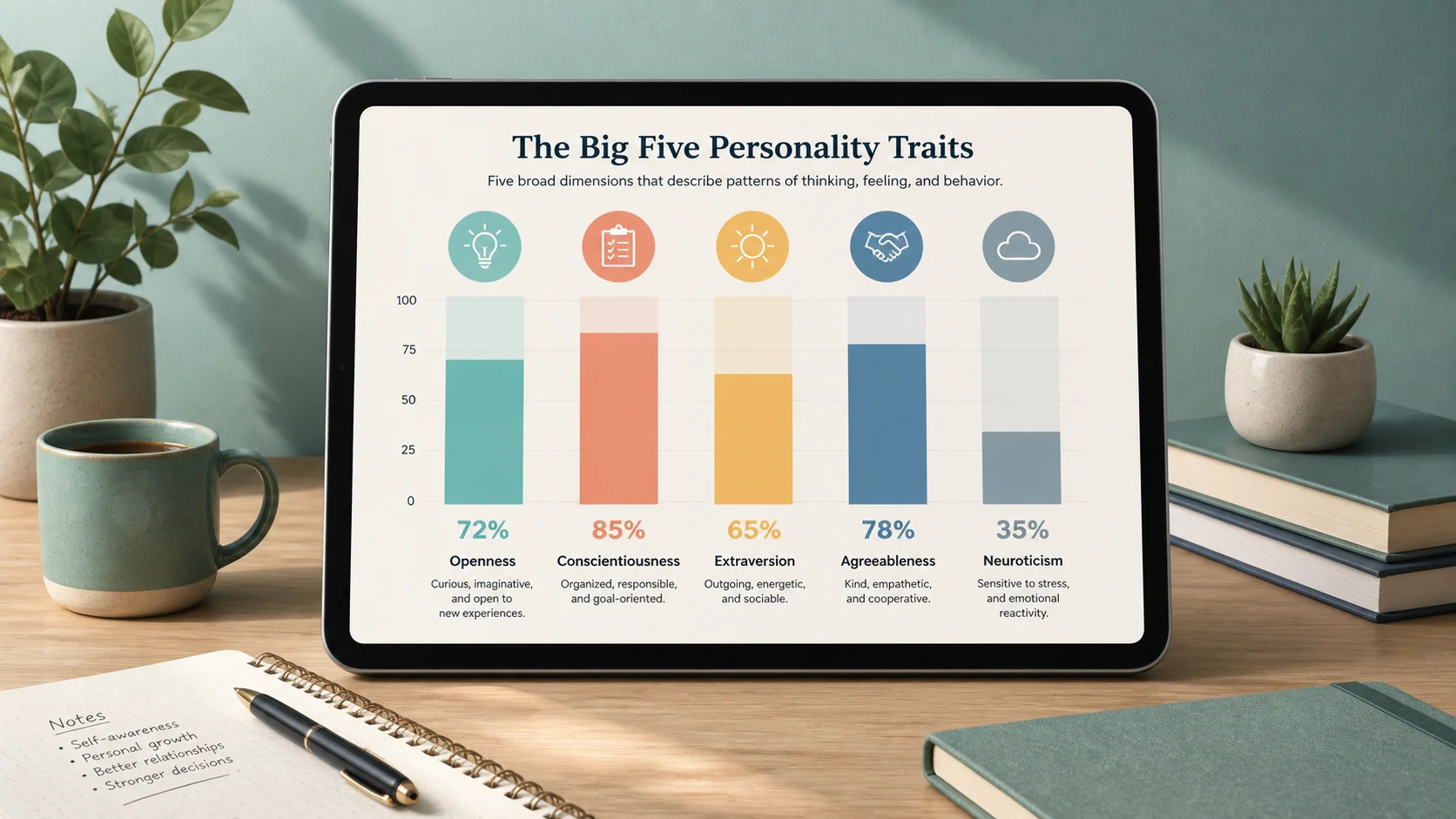
The Big Five Inventory, often shortened to BFI, is a self-report personality inventory built around the Five-Factor Model. It measures five broad trait dimensions, remembered by the acronym OCEAN: Openness to Experience, Conscientiousness, Extraversion, Agreeableness, and Neuroticism. Some sources describe the last dimension from the opposite direction as emotional stability, but the original BFI tradition commonly uses neuroticism.
Each dimension is continuous. A person is not simply "an extravert" or "not an extravert"; they receive a relative score that reflects how strongly they endorse statements connected with sociability, energy, imagination, orderliness, cooperation, or emotional reactivity. That is why the BFI is often more useful as a profile than as a type system. Two people can both score high in conscientiousness, for example, while differing sharply in openness or agreeableness.
The BFI was developed by Oliver P. John, Eileen M. Donahue, and Robert L. Kentle in 1991. It became popular because it offered a practical balance: short enough for surveys and classroom use, yet broad enough to cover the five major domains of personality. Later research and teaching materials often cite the original 1991 inventory alongside broader Big Five taxonomy chapters by John, Srivastava, Naumann, Soto, and other personality researchers.
What Are the 44 Items in the BFI-44?
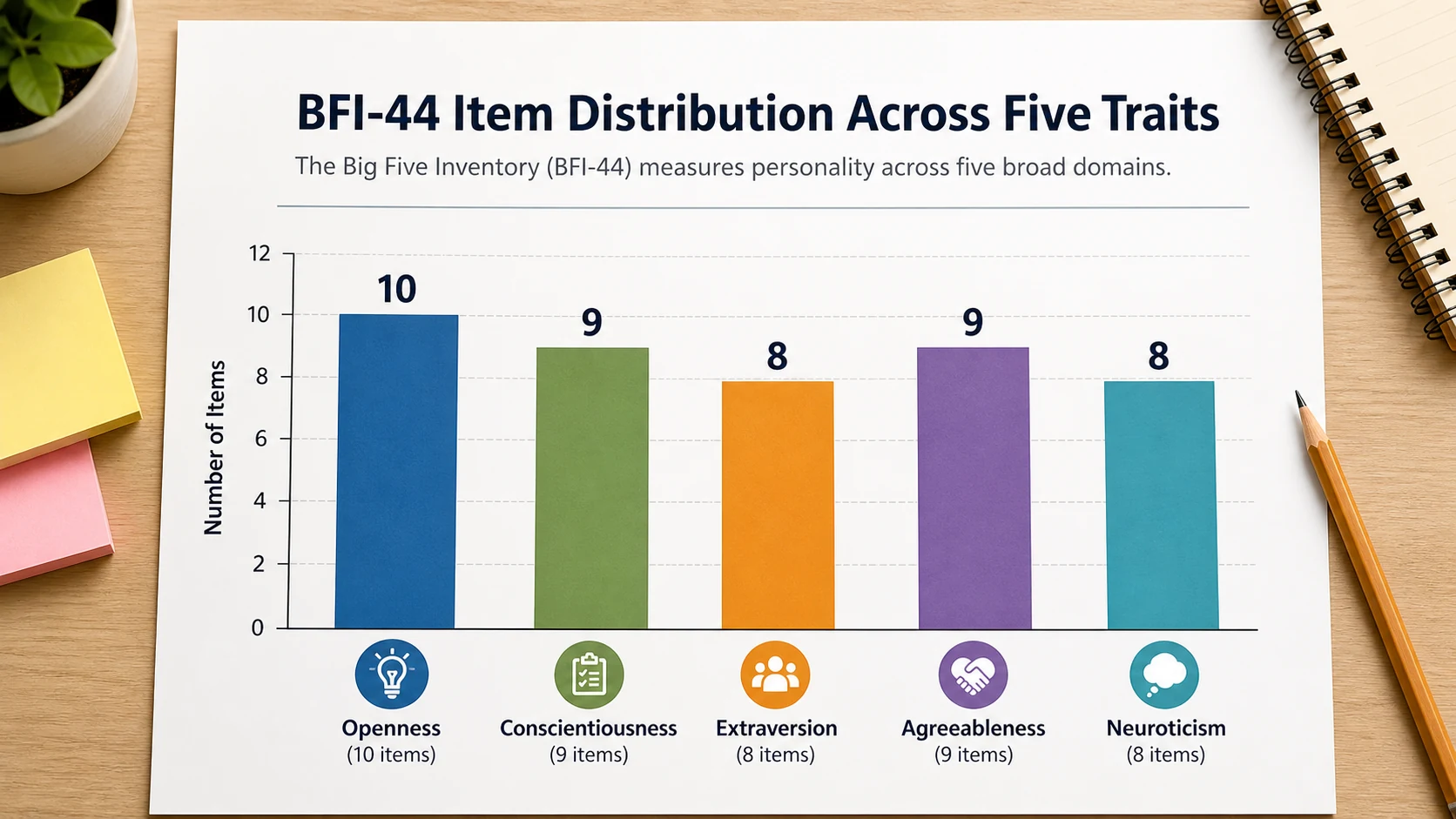
The classic BFI-44 uses 44 brief statements that respondents rate on a five-point agreement scale. The exact wording belongs in the official questionnaire source, so the safest way to understand the structure is to look at how the items are distributed across the five traits rather than copying a full item list.
| Trait | Item count | What the items usually tap |
|---|---|---|
| Openness | 10 | curiosity, imagination, ideas, aesthetics, novelty |
| Conscientiousness | 9 | organization, follow-through, reliability, self-discipline |
| Extraversion | 8 | sociability, energy, assertiveness, positive expressiveness |
| Agreeableness | 9 | cooperation, kindness, trust, consideration |
| Neuroticism | 8 | worry, mood shifts, stress sensitivity, emotional reactivity |
Many items are phrased as short self-descriptions. A respondent indicates how much each statement describes them, usually from strong disagreement to strong agreement. Some items are reverse-keyed, meaning agreement points toward the lower end of that trait. Reverse-keyed wording helps reduce one-sided answering patterns, but it also means scoring must be done carefully.
How to Calculate Big Five Inventory Scores
To calculate BFI-44 scores, start by assigning each answer a number, usually 1 through 5. Then reverse-score the negatively keyed items. On a 1-to-5 scale, reverse scoring is simple: subtract the original answer from 6. A 1 becomes 5, a 2 becomes 4, a 3 stays 3, a 4 becomes 2, and a 5 becomes 1.
After reversing the relevant items, average the items for each trait. Averaging is often easier to interpret than summing because every trait score stays on the same 1-to-5 scale even though the traits have different item counts. A higher average generally means stronger endorsement of that trait domain, not a better or healthier personality.
Common BFI-44 scoring keys group the item numbers this way:
| Trait | Items to average after reverse scoring |
|---|---|
| Extraversion | 1, 6R, 11, 16, 21R, 26, 31R, 36 |
| Agreeableness | 2R, 7, 12R, 17, 22, 27R, 32, 37R, 42 |
| Conscientiousness | 3, 8R, 13, 18R, 23R, 28, 33, 38, 43R |
| Neuroticism | 4, 9R, 14, 19, 24R, 29, 34R, 39 |
| Openness | 5, 10, 15, 20, 25, 30, 35R, 40, 41R, 44 |
For personal use, scores are best read as a pattern. A high conscientiousness score may suggest a preference for planning and persistence; a lower score may suggest flexibility and spontaneity. A high neuroticism score may suggest stronger sensitivity to stress or negative emotion; a lower score may suggest steadier emotional reactions. None of these scores proves what someone can or cannot do.
If you prefer a guided format instead of manual scoring, an OCEAN personality test can help translate five trait scores into a more readable self-reflection profile.
BFI-10, BFI-20, BFI-44, and BFI-2: Which Version Fits?
People searching for a Big Five Inventory PDF often find several versions. The right choice depends on context.
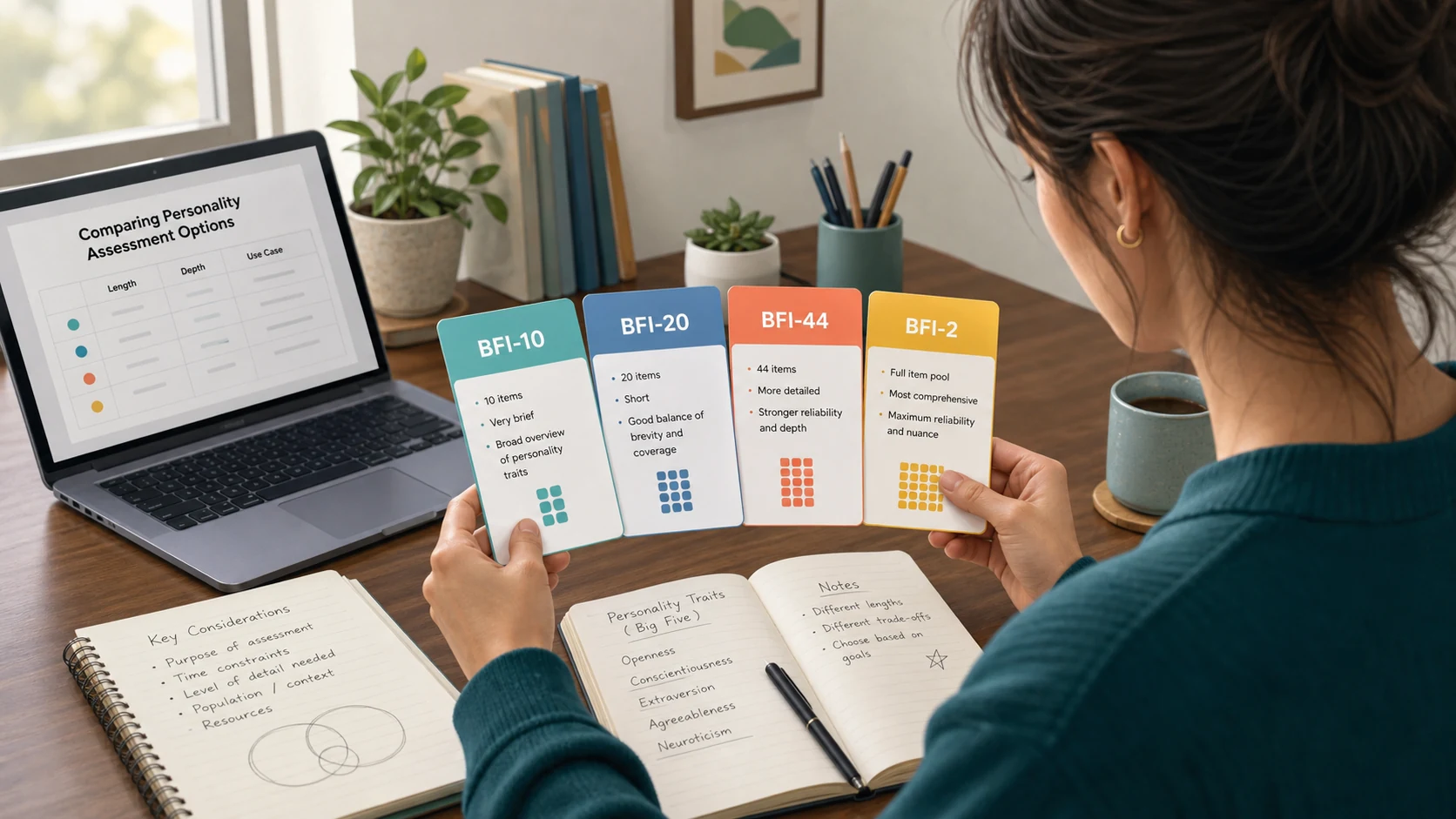
BFI-44 is the classic version. It is short enough for many research projects and long enough to give each domain several items. That makes it useful when you want a compact but reasonably stable profile of the five broad traits.
BFI-10 is an ultra-short version developed for situations where time is extremely limited. It can be useful in large surveys, but it gives only two items per trait. That brevity is convenient, yet it makes individual-level interpretation less dependable. It is better for broad research contexts than for deep personal interpretation.
BFI-20 versions are middle-ground short forms. They are useful when researchers need something shorter than 44 items but more balanced than a 10-item measure. Exact wording and validation can vary by adaptation, so users should check the source, population, and citation before relying on a particular PDF.
BFI-2 is a newer 60-item inventory. It expands the Big Five structure by adding facet-level detail under each broad trait. If someone needs more nuance, BFI-2 may be a better fit than BFI-44, though it takes longer and has its own citation and permission considerations.
For everyday self-understanding, the practical question is not only "Which test is shortest?" but "What decision will I make from the result?" A brief inventory can be enough for curiosity. A research project, coaching process, or workplace learning program should care more about permissions, validation, administration conditions, and how results are explained.
Is the Big Five Inventory Free to Use?
The answer depends on the version and the use case. Many Big Five materials are available for educational or non-commercial research use, but that does not automatically mean every PDF, translation, online adaptation, or commercial implementation is unrestricted. BFI-10 sources, for example, may have their own non-commercial terms and requested citations. BFI-2 materials have separate authorship and citation rules.
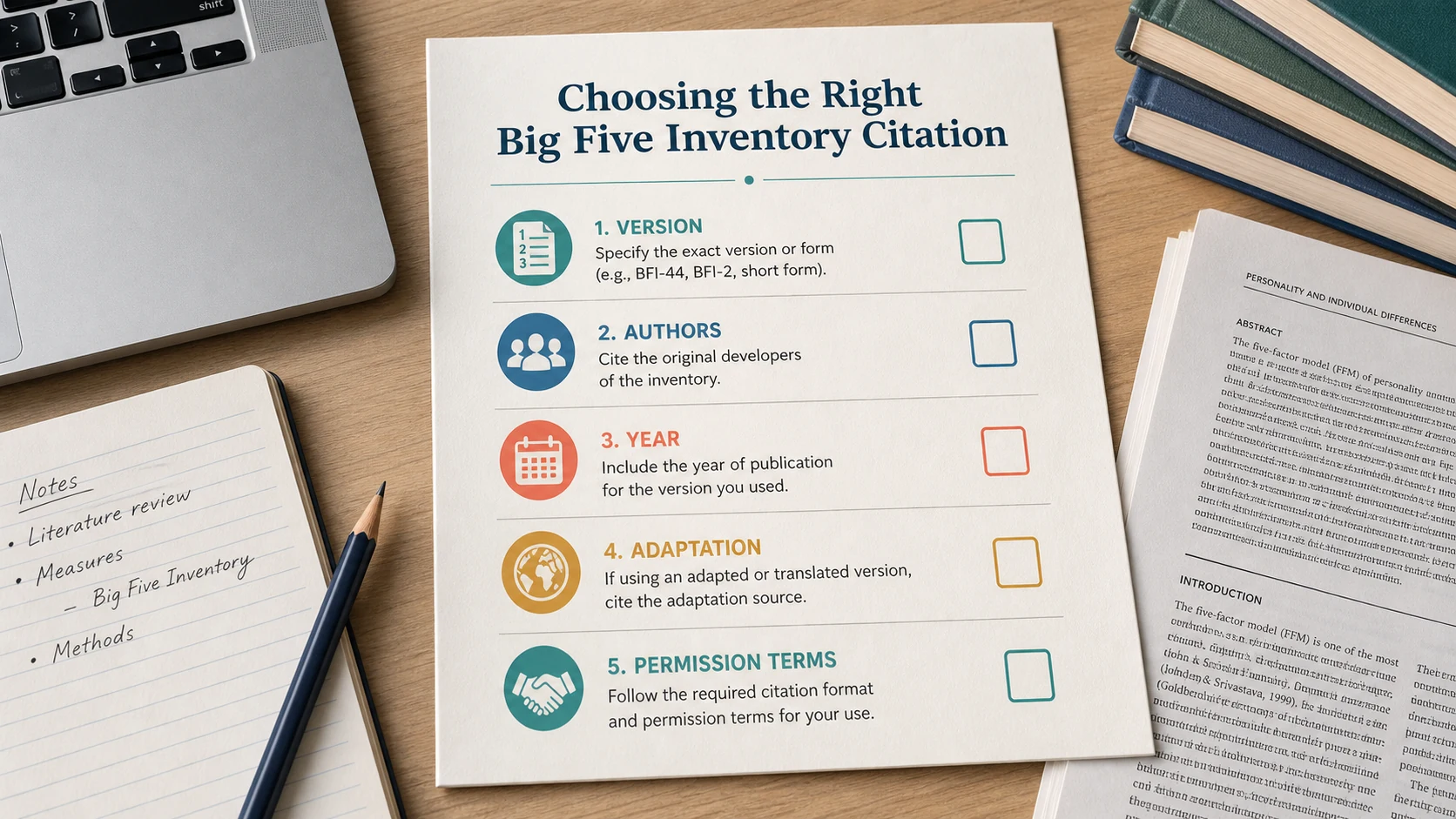
Before using any Big Five inventory in a class, study, product, hiring workflow, or coaching package, check three things. First, verify the exact instrument name and version. Second, read the permission statement from the source that provides the items. Third, cite the scale and any adaptation you actually used. This matters because "Big Five test" is a broad phrase, while "BFI-44," "BFI-10," and "BFI-2" point to different instruments.
For personal exploration, a free online assessment can be helpful as long as it is framed honestly. It should explain the five traits, avoid claiming perfect accuracy, and remind users that personality scores are starting points for reflection.
How to Cite the Big Five Inventory
If you use the classic BFI-44 in academic writing, the core citation usually points to John, Donahue, and Kentle's 1991 inventory from the University of California, Berkeley, Institute of Personality and Social Research. Many papers also include a later Big Five taxonomy chapter for theoretical background, such as John, Naumann, and Soto's chapter in the third edition of the Handbook of Personality.
A plain citation note might look like this in prose: the Big Five Inventory was developed by John, Donahue, and Kentle in 1991, and the broader Big Five trait taxonomy is commonly discussed in John, Naumann, and Soto's 2008 handbook chapter. If you are using BFI-10, cite Rammstedt and John. If you are using BFI-2, cite Soto and John. If you are using a translation or adapted local version, cite that adaptation too.
The most common citation mistake is mixing versions. Do not cite BFI-44 for a BFI-10 questionnaire or cite BFI-2 for a classic 44-item form. Match your reference list to the actual scale administered.
What Is the Most Accurate Big 5 Test?
No single Big Five test is "most accurate" for every purpose. Accuracy depends on the instrument, the sample, the language, the scoring method, and how results are interpreted. Longer instruments often capture more information, but they can also increase respondent fatigue. Very short instruments are efficient, but they usually sacrifice detail.
For research, the best choice is usually a validated inventory matched to the study population and administration setting. For personal growth, the best choice is a clear, transparent test that explains the five traits as continua and avoids turning scores into rigid types. For professional settings, the best choice is one used ethically, with informed consent and careful interpretation.
The Big Five model is strong because it has broad research support, but a score still reflects self-report at one point in time. Mood, language, context, and self-awareness can all influence responses. Treat the result as a map of tendencies, not a verdict on identity.
Using a Big Five Inventory as a Self-Reflection Tool
The most useful way to read a big five inventory result is to ask what the profile helps you notice. High openness may point toward curiosity and comfort with novelty. High conscientiousness may point toward planning and follow-through. High extraversion may point toward energy from social engagement. High agreeableness may point toward cooperation and empathy. High neuroticism may point toward stronger sensitivity to stress or threat.
Lower scores can also contain strengths. Lower openness may support consistency and practicality. Lower conscientiousness may support adaptability. Lower extraversion may support deep focus. Lower agreeableness may support directness and boundary-setting. Lower neuroticism may support calm under pressure. The value comes from context, not from treating one end of a trait as automatically good.
After reviewing your score pattern, choose one everyday question: Where does this trait help me? Where does it create friction? What small behavior would make the trait work better for my current goal? A science-backed personality profile can support that reflection by turning scores into readable trait explanations while keeping the focus on learning rather than labels.
FAQ
What are the 44 items in the Big Five Inventory?
The BFI-44 contains 44 brief self-report statements rated on a five-point agreement scale. The items are distributed across Openness, Conscientiousness, Extraversion, Agreeableness, and Neuroticism. Because the exact item wording should be taken from the official scale source, it is better to use an authorized questionnaire or PDF than to copy items from an unverified page.
How do you calculate a Big Five Inventory score?
Assign each response a 1-to-5 value, reverse-score the items marked R, then average the items for each trait. On a five-point scale, reverse scoring usually means subtracting the response from 6. The result is five domain averages rather than one total personality score.
Who developed the Big Five Inventory?
The classic BFI is generally credited to Oliver P. John, Eileen M. Donahue, and Robert L. Kentle in 1991. Later versions and short forms have different authors and citations, so match the citation to the exact version you use.
What is the difference between BFI-10 and BFI-44?
BFI-10 uses two items per trait and is designed for very short surveys. BFI-44 uses 44 items, with 8 to 10 items per trait, so it usually provides a fuller broad-domain profile. BFI-10 is efficient, while BFI-44 offers more measurement coverage.
Is the Big Five Inventory free to use?
Some versions are available for educational or non-commercial research use, but permission can depend on the version, translation, and context. Always check the source terms before using a BFI PDF in a product, workplace program, or formal study.
Is a Big Five inventory the same as a Big 5 personality test?
Not always. A Big Five inventory is a specific questionnaire or family of questionnaires. A Big 5 personality test is a broader phrase that can include BFI versions, IPIP-based tests, BFI-2, NEO-style measures, and other OCEAN assessments.
Can Big Five scores change over time?
Yes, trait patterns can shift gradually with age, life experience, environment, and intentional behavior. However, Big Five scores are usually interpreted as relatively stable tendencies, not moment-by-moment moods.
Should I use a Big Five inventory for hiring decisions?
Use caution. Big Five results can support learning and team conversations, but they should not be used as a stand-alone hiring filter. Professional settings need informed consent, privacy care, validated tools, and fair interpretation.