Different Personality Types Explained: 4 Types, 16 Types, and Big Five Traits
Searches for different personality types often lead to several systems at once: the 4 personality types, Type A/B/C/D, the 16 personality types in MBTI-style frameworks, introvert and extrovert labels, and trait-based psychology models such as the Big Five. That can be useful, but it can also feel messy. These systems do not all measure the same thing, and none of them should be treated as a fixed identity. A better approach is to use personality types as simple maps, then compare them with trait-based tools such as a Big Five personality profile when you want a more nuanced view of your patterns.
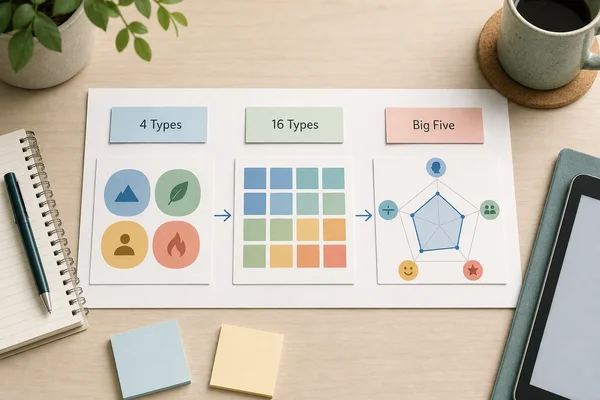
What People Mean by Different Personality Types
The phrase "personality type" usually means a named category that describes a broad pattern in how someone thinks, feels, decides, relates, or works. A type can be memorable because it turns a complex person into a short label: Type A, INFJ, introvert, achiever, helper, or another familiar shorthand.
The tradeoff is that people rarely fit one label perfectly. A person may be reserved at work but lively with close friends. Someone may enjoy structure for finances and travel plans, yet prefer spontaneity in creative projects. Personality is usually better understood as a pattern of tendencies rather than a single box.
That is why it helps to separate three ideas:
- A type groups people into named categories.
- A trait measures where someone falls on a continuum.
- A test or assessment is the tool used to estimate a type or trait pattern.
When readers ask "what are the different personality types," they are often asking for a quick guide to the major systems and what each one is good for. The answer is not one master list. It is a set of lenses.
The 4 Personality Types: A, B, C, and D
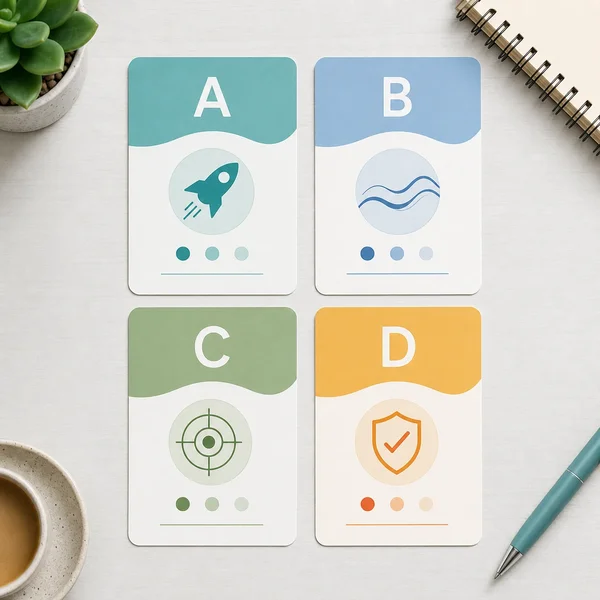
The 4 personality types are commonly discussed as Type A, Type B, Type C, and Type D. This system is popular because the labels are simple and easy to remember.
Type A is often described as ambitious, competitive, time-conscious, and goal-focused. In everyday language, a Type A person may like deadlines, high standards, and visible progress. The risk is that the label can become too harsh if it turns normal drive into a stereotype.
Type B is often described as relaxed, flexible, social, and easygoing. A Type B person may be comfortable adapting to changing plans and may prefer a less pressured pace. The risk is assuming that relaxed means unmotivated, which is not always true.
Type C is often described as careful, detail-oriented, analytical, and precise. People who relate to this label may like evidence, structure, and high-quality work. The risk is reducing thoughtful caution to anxiety or rigidity.
Type D is often described as more emotionally restrained, cautious, or prone to worry in stressful settings. This label should be handled with care because emotional patterns can overlap with stress, context, and mental health concerns. It is best used as a reflection prompt, not as a clinical label.
The 4-type model can be useful for quick workplace or communication conversations, especially when the goal is to notice differences in pace, decision-making, and interaction style. Its weakness is that it is broad. It does not explain the many ways a person can be both driven and cooperative, both careful and creative, or both sociable and easily overstimulated.
The 16 Personality Types in MBTI-Style Systems
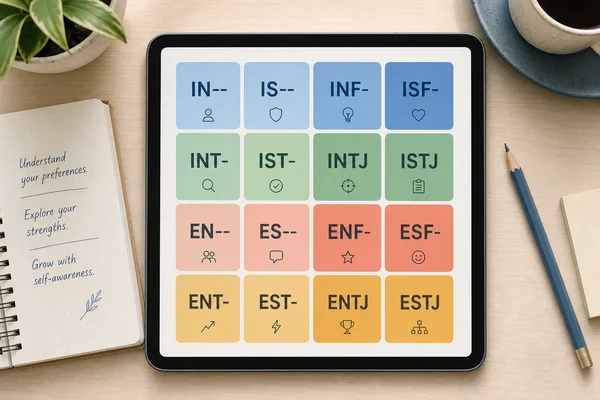
The 16 personality types are usually associated with four preference pairs: introversion or extraversion, sensing or intuition, thinking or feeling, and judging or perceiving. Combining one side of each pair creates a four-letter type such as INFJ, ISTJ, ENFP, or ESTP.
Many people enjoy this system because the types feel vivid. They describe common preferences in energy, information processing, decision-making, and lifestyle structure. For example, an INFJ profile is often associated with reflection, meaning, long-range insight, and concern for people. An ESTP profile is often associated with action, adaptability, and hands-on problem solving.
The 16-type approach is especially useful when someone wants language for subjective preferences. It can help a reader ask:
- Do I recharge through solitude, social contact, or a mix of both?
- Do I trust concrete facts first, or do I naturally look for patterns?
- Do I decide by detached logic, personal values, or both depending on the stakes?
- Do I prefer closure and plans, or do I like options to stay open?
The limitation is that a four-letter code can feel more precise than it really is. People change across roles, relationships, stress levels, and life stages. Two people with the same type may still differ dramatically in maturity, values, skills, culture, and emotional habits. For that reason, the 16 types work best as conversation starters rather than final explanations.
Different Personality Types in Psychology: Why Traits Matter
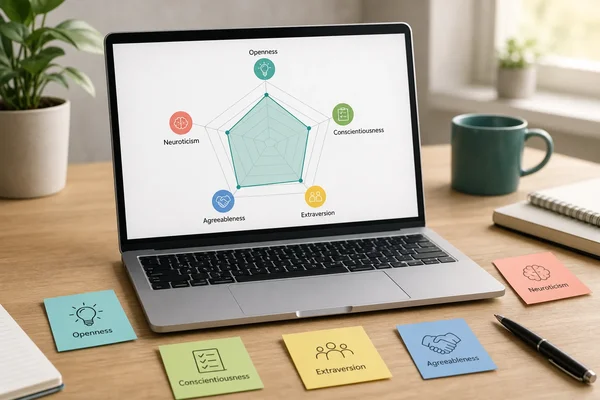
In psychology, personality is often studied through traits rather than fixed categories. A trait model asks how strongly a person tends to show a pattern, not which single box they belong in. The Big Five, also called the Five-Factor Model or OCEAN, is one of the best-known trait frameworks.
The Big Five looks at five broad dimensions:
- Openness: curiosity, imagination, and interest in new ideas or experiences.
- Conscientiousness: organization, follow-through, dependability, and self-discipline.
- Extraversion: social energy, assertiveness, enthusiasm, and stimulation seeking.
- Agreeableness: cooperation, compassion, trust, and concern for harmony.
- Neuroticism: emotional sensitivity, stress reactivity, and tendency toward worry.
This matters because trait scores can show mixed patterns that type labels may hide. Someone might be introverted but highly open to ideas. Another person might be agreeable in relationships but very direct under work pressure. A third may be conscientious in long-term goals but low in daily tidiness.
That is why exploring your Big Five traits can add depth to type-based self-reflection. Instead of asking "which type am I," a trait lens asks "where do my patterns tend to fall, and how do they show up in real life?"
The Big Five does not make type systems useless. It simply answers a different question. Type systems give memorable language. Trait systems give gradients. Used together, they can help you hold personality more lightly and accurately.
How to Read Personality Type Meanings Without Overlabeling Yourself
Personality type meanings are most useful when you treat them as hypotheses. A good type description should make you think, "That pattern often fits me," not "This label explains everything about me."
Use this quick filter when reading any personality type description:
- Look for patterns, not perfect matches. A useful description should fit your repeated tendencies, not every moment of your life.
- Separate preference from skill. You may prefer quiet work but still be excellent in group settings.
- Notice context. Your family role, job demands, culture, stress level, and current season of life can all shape behavior.
- Watch for flattering bias. Many type descriptions are written to feel personally meaningful. Ask what the description helps you do differently.
- Avoid using types to rank people. A type is not a measure of worth, intelligence, kindness, or potential.
- Revisit your interpretation. Personality can become clearer as you collect more real-life evidence.
This is especially important for keywords such as "different male personality types" or "personality types in the workplace." Those searches can easily drift into stereotypes. A better question is: which traits, preferences, or behavior patterns are relevant to the situation? In a team, for example, communication pace and decision style may matter more than a label. In relationships, emotional regulation, trust, and listening may matter more than whether someone calls themselves introverted or extroverted.
Personality Tests and Tools: Choosing the Right Lens
Different personality tests serve different purposes. If you want a quick, memorable label, a type-based tool may feel satisfying. If you want a more detailed self-reflection framework, a trait-based test may be more useful.
Choose your lens based on the question you are trying to answer:
- For a simple social shorthand, introvert and extrovert language may be enough.
- For a broad workplace conversation, Type A/B/C/D may highlight pace, detail orientation, and interaction style.
- For preference language, the 16 personality types can help you describe energy, information, decisions, and structure.
- For a more research-aligned personal profile, the Big Five can show your pattern across five continuous dimensions.
- For mental health concerns, personality content should not replace support from a qualified professional.
Be careful with searches about "different types of personality disorders." Personality types and personality disorders are not the same topic. Personality types are broad self-reflection labels. Personality disorders are clinical concepts that require professional evaluation and should not be inferred from a casual type description or online quiz.
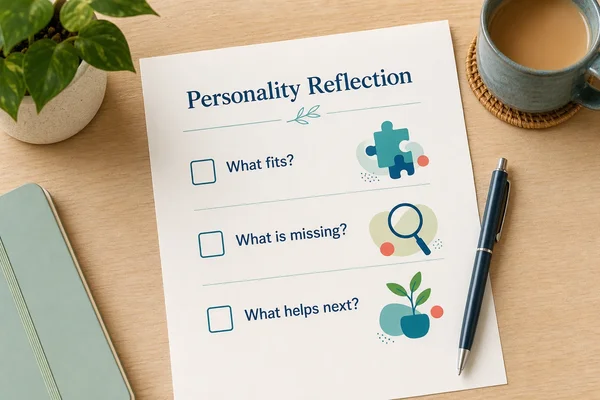
A practical way to use any tool is to write down three things after reading your result: what feels accurate, what feels incomplete, and what action would be kind and realistic. For example, a person who scores high in conscientiousness might plan recovery time so their standards do not become constant pressure. A person high in openness might create structure for finishing ideas. A person high in neuroticism might build a calmer routine and seek extra support when stress feels hard to manage.
Use Different Personality Types as a Starting Point for Self-Understanding
Different personality types can be genuinely helpful when they give you language for patterns you already notice. They become less helpful when they make you feel stuck, superior, inferior, or overly certain about another person.
The strongest use of personality frameworks is reflective and flexible. You can use the 4 personality types to discuss pace and work style. You can use the 16 personality types to explore preferences. You can use introversion and extraversion to understand energy. And you can use the Big Five to see a more detailed trait profile across OCEAN dimensions.
If you want to move from broad labels toward practical self-knowledge, Big Five self-understanding tools can help you compare your tendencies across multiple traits without reducing you to one name. Treat the result as a starting point for observation: What patterns help you thrive? Which habits create friction? What would make daily life a little clearer, kinder, or more sustainable?
FAQ
What are the 4 personality types?
The 4 personality types usually refer to Type A, Type B, Type C, and Type D. Type A is often linked with drive and competitiveness, Type B with flexibility and sociability, Type C with detail focus and analysis, and Type D with caution or emotional restraint. These are broad labels, so they should be used for reflection rather than firm judgment.
What are Type A, B, C, and D personalities?
Type A is commonly described as goal-oriented and fast-paced. Type B is often described as relaxed and adaptable. Type C is usually careful, precise, and analytical. Type D is often associated with worry, restraint, or discomfort in stressful situations. Many people show a blend of these patterns.
What are the 16 personality types?
The 16 personality types are four-letter combinations based on preference pairs: E/I, S/N, T/F, and J/P. Examples include INFJ, INFP, INTJ, ISTJ, ENFP, ENFJ, ESTP, and ESFJ. The system is popular because it gives memorable language for common preferences, but it should not be treated as a complete picture of a person.
What are the 12 types of personality?
Searches for 12 personality types often refer to zodiac signs, not a mainstream psychology assessment. Zodiac categories can be culturally meaningful for some people, but they are different from psychological trait models such as the Big Five or preference systems such as the 16 personality types.
How many different personality types are there?
There is no single agreed number. It depends on the framework. Some systems use 4 types, some use 9, some use 12, and some use 16. Trait-based psychology does not always use types at all; it may measure people across continuous dimensions instead.
Are personality types the same as personality disorders?
No. Personality types are informal or assessment-based categories used for self-reflection, communication, and learning. Personality disorders are clinical concepts. If someone is worried about mental health, distress, relationships, or safety, they should speak with a qualified professional rather than relying on a personality type label.
Is INFJ a personality type?
Yes. INFJ is one of the 16 personality types in MBTI-style systems. It combines introversion, intuition, feeling, and judging preferences. People often associate INFJ with reflection, empathy, meaning, and long-range thinking, but any four-letter type is still only a partial description.
Is the Big Five better than personality types?
The Big Five is different from most type systems because it measures traits on continua instead of placing people into one category. That often makes it more nuanced for self-understanding. Type systems can still be useful for simple language, while the Big Five is often stronger when you want a more detailed profile of your tendencies.