Personality Descriptors: Definitions, Examples, and a Big Five List
Personality descriptors are words or short phrases that help explain how a person tends to think, feel, communicate, and act. They can be simple adjectives like curious, cautious, warm, organized, intense, playful, or reserved. They can also be more specific phrases, such as "careful with deadlines" or "energized by group discussion." Used well, personality descriptors make self-reflection clearer without turning people into rigid labels. If you want to connect everyday words with a science-backed trait framework, a Big Five self-reflection tool can help you compare descriptors with broader OCEAN patterns.

What Are Personality Descriptors?
A personality descriptor names a recurring pattern, not a whole identity. "Assertive" may describe how someone speaks up in meetings. "Reflective" may describe how they pause before deciding. "Impulsive" may describe a tendency to act quickly when emotions or opportunities are strong. None of these words explains everything about a person, but each one can point to a pattern worth noticing.
This is why descriptors are useful in school, writing, hiring conversations, coaching, relationships, and personal growth. They give people shared language. A teacher might say a student is persistent because the student keeps trying after mistakes. A writer might call a fictional character guarded because the character avoids sharing private feelings. A manager might describe a teammate as dependable because that person follows through consistently.
The safest way to use descriptors is to pair the word with evidence. Instead of saying, "She is responsible," say, "She is responsible because she tracks assignments, asks clarifying questions, and finishes work on time." That keeps the descriptor grounded in behavior.
Personality Traits, Character Traits, and Physical Traits
Searchers often mix personality descriptors with character traits and physical character traits. The overlap is real, but the terms are not identical.
Personality traits describe patterns in temperament, preference, emotion, and behavior. Examples include sociable, analytical, flexible, cautious, energetic, imaginative, and patient. These words often answer the question: "How does this person usually approach life?"
Character traits usually carry a moral or values-based meaning. Honest, brave, fair, loyal, selfish, and generous are character traits because they imply choices, ethics, or social responsibility. A student-friendly character traits definition might be: a character trait is a quality shown through what someone says, does, chooses, or feels across a story or real situation.
Physical traits describe appearance or bodily features, such as tall, athletic, graceful, slight, strong, or expressive. A physical trait may hint at personality in a story, but it is not the same as personality. Someone can look polished and still be anxious, playful, strict, or deeply private.
A Practical Personality Descriptors List
Below is a balanced list of personality descriptors. It is not a complete list of 100 character traits or 1,000 adjectives, but it gives enough range for real-life reflection, student writing, and character creation.
Positive descriptors of a person:
- Adaptable
- Affectionate
- Analytical
- Brave
- Calm
- Compassionate
- Conscientious
- Creative
- Dependable
- Diplomatic
- Encouraging
- Fair-minded
- Focused
- Friendly
- Generous
- Honest
- Imaginative
- Independent
- Organized
- Patient
- Practical
- Resilient
- Sincere
- Thoughtful
- Trustworthy
Neutral or context-dependent descriptors:
- Assertive
- Cautious
- Competitive
- Detail-oriented
- Direct
- Emotional
- Introverted
- Observant
- Perfectionistic
- Private
- Questioning
- Reserved
- Sensitive
- Spontaneous
- Traditional
Challenging descriptors:
- Argumentative
- Avoidant
- Careless
- Controlling
- Defensive
- Impatient
- Inconsistent
- Moody
- Overconfident
- Reactive
- Rigid
- Self-critical
- Stubborn
- Withdrawn
Notice that many descriptors are not purely good or bad. Direct communication can be helpful when clarity matters and harsh when empathy is missing. Caution can prevent mistakes and also slow action. Sensitivity can support empathy and also make criticism feel heavier. Context matters.
How Descriptors Connect to the Big Five
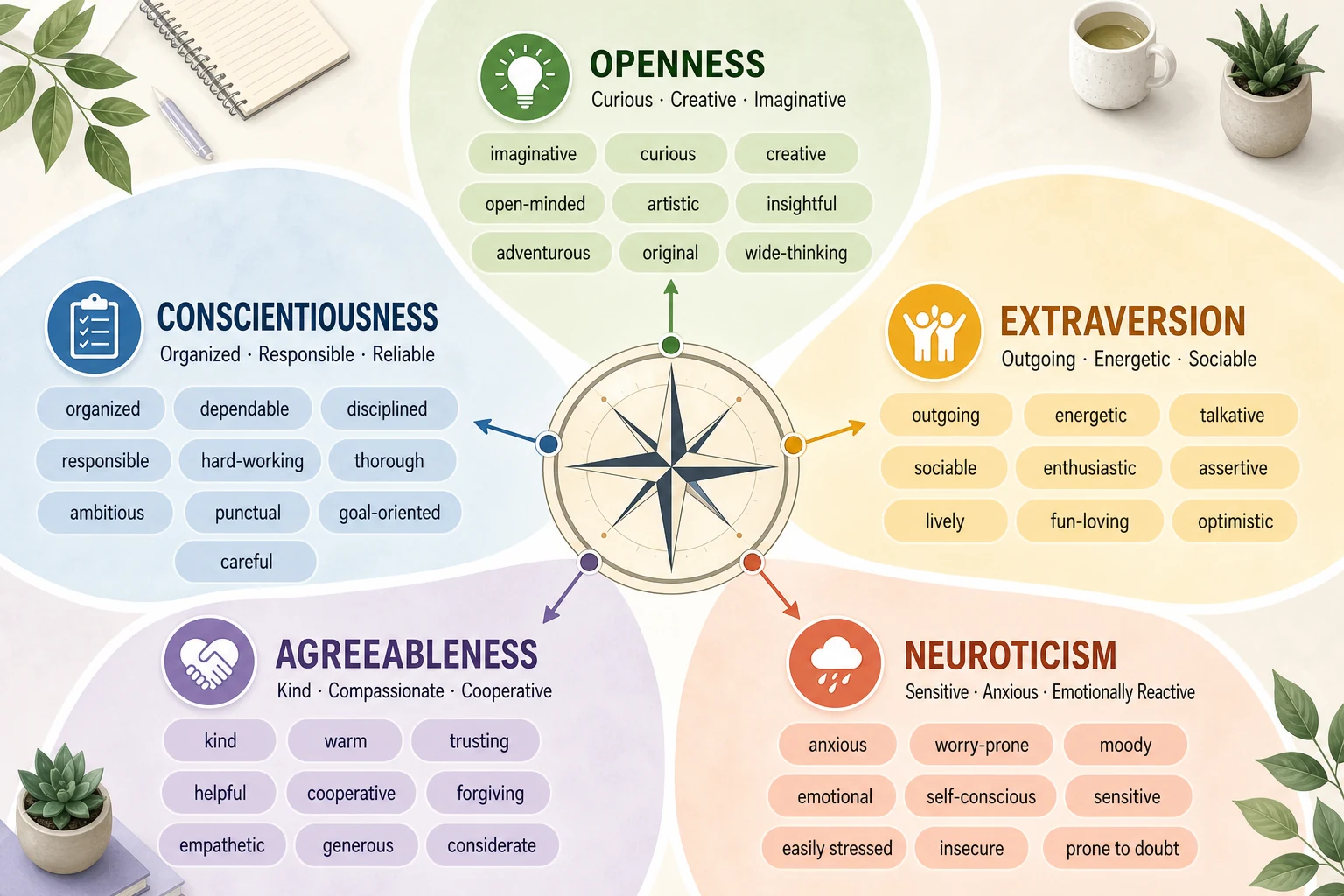
The Big Five model groups personality into five broad dimensions: openness, conscientiousness, extraversion, agreeableness, and neuroticism. These dimensions are useful because they organize many descriptor words into larger patterns without forcing everyone into a small set of types.
Openness relates to curiosity, imagination, flexibility, and interest in new ideas. High-openness descriptors might include creative, exploratory, inventive, artistic, or unconventional. Lower-openness descriptors might include practical, traditional, routine-oriented, or concrete.
Conscientiousness relates to planning, follow-through, discipline, and reliability. Descriptors include organized, careful, diligent, punctual, persistent, and detail-oriented. Lower scores may show up as spontaneous, flexible, distractible, casual, or inconsistent, depending on context.
Extraversion relates to social energy, assertiveness, enthusiasm, and outward expression. Descriptors include outgoing, talkative, lively, bold, sociable, and energetic. Lower-extraversion descriptors include reserved, quiet, private, reflective, or independent.
Agreeableness relates to cooperation, empathy, trust, and consideration. Descriptors include warm, compassionate, forgiving, supportive, polite, and cooperative. Lower-agreeableness descriptors may include skeptical, blunt, competitive, guarded, or tough-minded.
Neuroticism relates to emotional reactivity and sensitivity to stress. Descriptors include anxious, self-critical, emotionally intense, vigilant, easily frustrated, or sensitive. Lower-neuroticism descriptors include steady, calm, even-tempered, relaxed, and resilient.
If you want more structure than a word list can provide, an OCEAN-based personality test can show how clusters of descriptors may relate to broader trait dimensions. The point is not to reduce someone to a score. It is to turn scattered observations into a more useful pattern.
Personality Traits Examples in Real Life
Real-life examples make descriptors easier to understand. A descriptor becomes more meaningful when you can see the behavior behind it.
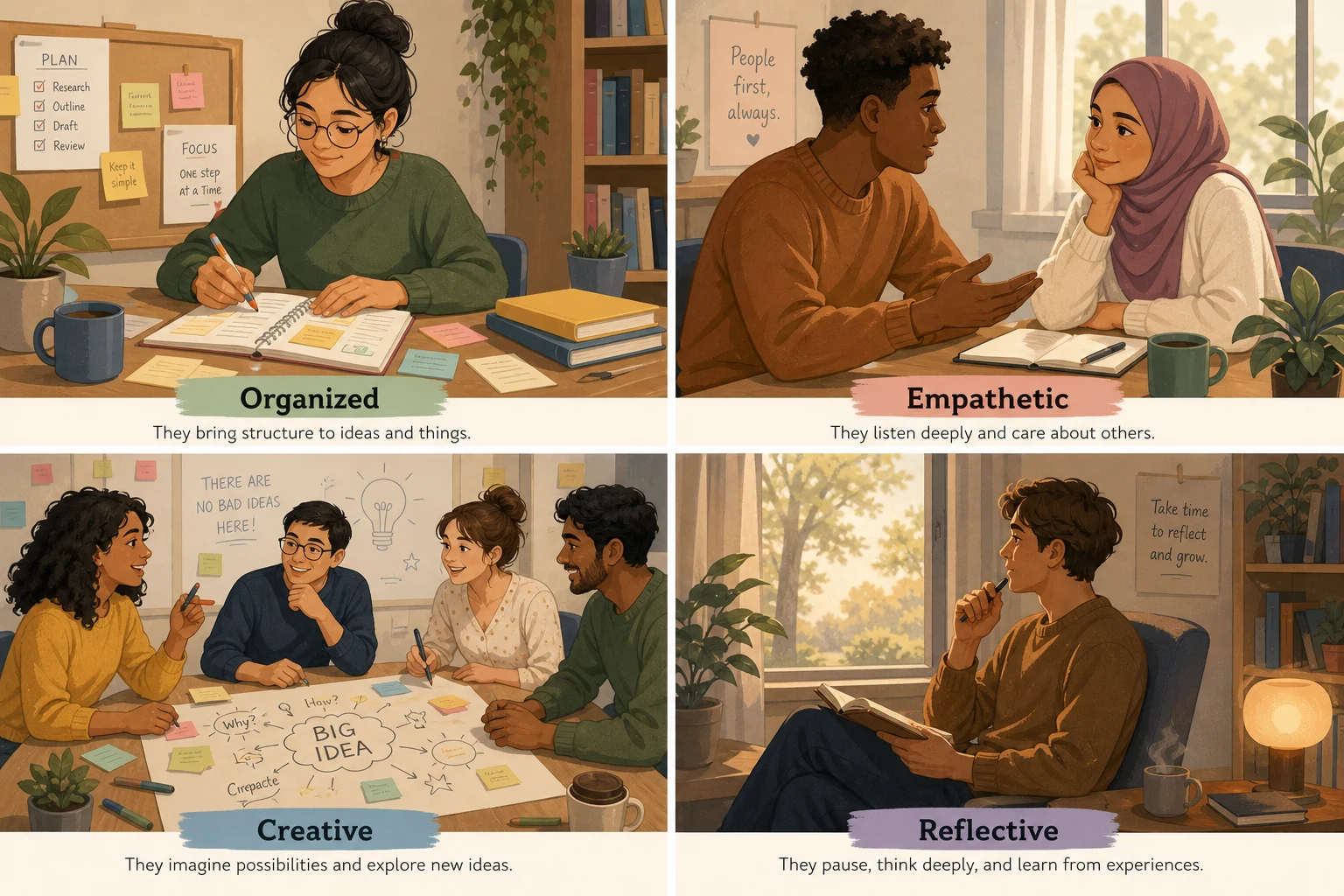
A conscientious person might keep a shared calendar, prepare before deadlines, and notice small mistakes before they become larger problems. In school, this may look like bringing materials, revising work, and finishing assignments. In a workplace, it may look like reliable follow-through.
An agreeable person might listen carefully, soften conflict, and check how decisions affect others. In real life, this can be a friend who remembers what matters to you or a teammate who helps quieter people enter the conversation.
An open person may enjoy unfamiliar ideas, unusual hobbies, new books, or creative problem-solving. A student high in openness might ask "what if" questions. A fictional character high in openness might leave home to explore a strange opportunity.
An extraverted person may gain energy from group activity, speak easily in social spaces, and enjoy active collaboration. A more introverted person may prefer fewer conversations, deeper focus, or time alone after busy events. Both patterns can be strengths.
A person high in emotional sensitivity may notice subtle shifts in tone, react strongly to uncertainty, or replay uncomfortable moments. That same sensitivity can support empathy, preparation, and careful risk awareness when handled constructively.
How to Choose Better Descriptors for a Person
Good descriptors are specific, fair, and supported by examples. Before choosing a word, ask three questions.
First, what behavior did I actually observe? "She is thoughtful" is stronger when connected to a concrete action, such as checking whether a classmate understood the instructions.
Second, does the word describe a pattern or a single moment? Anyone can be impatient once. A descriptor becomes more useful when the same tendency appears across situations.
Third, is there a more precise word? "Nice" is friendly but vague. Depending on the evidence, you may mean considerate, warm, cooperative, generous, tactful, or patient. "Difficult" is also vague. You may mean defensive, rigid, skeptical, reactive, or easily overwhelmed.
For students, a helpful formula is: descriptor + action + situation. For example: "Maya is persistent because she kept revising her science project after two failed tests." For character writing, try descriptor + pressure. For example: "Jonah is loyal until loyalty conflicts with honesty." For personal reflection, try descriptor + pattern + cost. For example: "I am detail-oriented at work, but I sometimes spend too long polishing small tasks."
Common Mistakes When Using Personality Descriptor Words
The first mistake is treating descriptors as permanent verdicts. Personality is relatively stable, but people still adapt by situation, age, role, stress level, and goals. "Reserved at parties" does not mean "unable to lead." "Sensitive during conflict" does not mean "weak."
The second mistake is using only positive descriptors. Personal growth requires a balanced vocabulary. Words like impatient, avoidant, reactive, or controlling can be useful when they are used carefully and privately for reflection, not as insults.
The third mistake is confusing brand descriptors with human personality descriptors. Personal brand descriptors such as bold, polished, expert, approachable, or innovative can describe how someone wants to be perceived. They may overlap with personality, but they are also shaped by audience, presentation, and goals.
The fourth mistake is relying on type labels alone. Searches like "what are the 16 types of personalities" often point to typology systems, but descriptor words and Big Five dimensions can be more flexible. They let you describe degree, context, and nuance instead of placing everyone into one box.
Turning Descriptors Into Self-Understanding
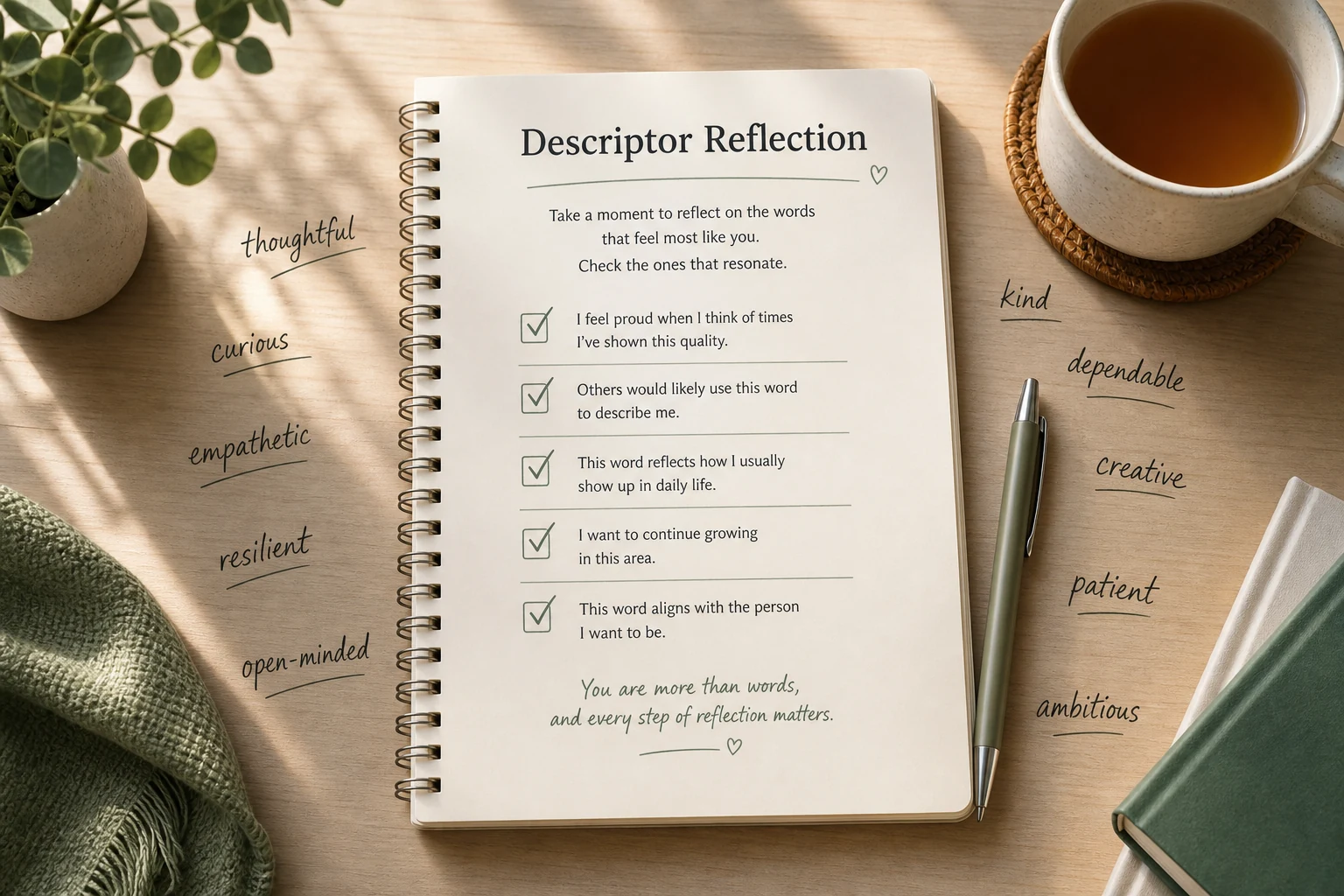
The best use of personality descriptors is reflection. Choose five words that feel accurate, then write one behavior that supports each word. Next, choose one descriptor that may be overused or underused in your life. A person who is highly independent may benefit from practicing collaboration. A person who is highly accommodating may benefit from clearer boundaries.
You can also compare your everyday descriptors with a broader trait model. If many of your words are organized, careful, punctual, and disciplined, they may point toward conscientiousness. If many are imaginative, curious, unconventional, and exploratory, they may point toward openness. If you want a gentle way to organize those patterns, you can explore a personality score framework and use the results as a conversation starter for self-understanding.
Personality descriptors are not final answers. They are working language. They help you notice patterns, explain behavior more fairly, and choose the next small action with more clarity.
FAQ
What are 50 character traits of a person?
Here are 50 useful character or personality traits: honest, loyal, brave, patient, curious, creative, dependable, kind, generous, fair, humble, disciplined, organized, thoughtful, confident, flexible, calm, energetic, sensitive, reflective, friendly, ambitious, cautious, practical, imaginative, persistent, cooperative, sincere, warm, direct, independent, resilient, observant, diplomatic, responsible, playful, analytical, forgiving, assertive, focused, open-minded, skeptical, cheerful, private, punctual, empathetic, adaptable, careful, trustworthy, and resourceful.
What are the 7 character traits?
There is no single universal set of seven character traits. In schools, common lists often include honesty, responsibility, respect, fairness, caring, courage, and perseverance. Other lists may use different values. For SEO and writing purposes, it is better to define the trait, show behavior, and explain the situation.
What are the 12 character traits?
A practical list of 12 character traits could include honesty, responsibility, courage, compassion, fairness, respect, perseverance, humility, loyalty, patience, self-control, and generosity. These are values-based traits, so they are slightly different from personality descriptors like quiet, outgoing, imaginative, or detail-oriented.
What are 100 character traits?
A list of 100 character traits usually combines positive, neutral, and challenging words. Rather than memorizing all 100, group them by meaning: social traits, emotional traits, work habits, moral traits, thinking style, and stress responses. Grouping helps students and writers choose more accurate words.
What are the 16 types of personalities?
"16 personalities" usually refers to type-based personality systems inspired by four-letter categories. The Big Five works differently. Instead of assigning one type, it describes people across five broad dimensions. That can make descriptors more flexible because a person can be both highly conscientious and moderately introverted, for example.
What is the difference between personal descriptors and personality descriptors?
Personal descriptors can include many kinds of details: appearance, role, values, skills, background, brand image, or personality. Personality descriptors are narrower. They focus on patterns in temperament, behavior, emotion, and social style, such as warm, cautious, analytical, organized, sensitive, or adventurous.